
Written by Nicholas Orlando, Melvyn New and Joan New Editing Intern
When I began my Ph.D. in 2020, I had hoped to work in academic publishing in some capacity. This side of academia held a mystique that, for me, other areas lacked or lost. By 2020, I was the instructor of record for several college-level courses, I had submitted a few essays of my own for publication, and I (sort of) understood what a career in humanities research meant. Academic publishing seemed like a place in which all of my experiences in writing, teaching, and researching could come together in some strange Cronenbergian amalgam. However, although I had been in touch with editors from academic journals and edited collections, I, perhaps like many graduate students, really had no idea what happened inside a press’s four walls. In fact, I don’t think working in academic publishing was discussed during my undergraduate or masters-level educations, save for brief mentions in larger conversations about prospective career trajectories.
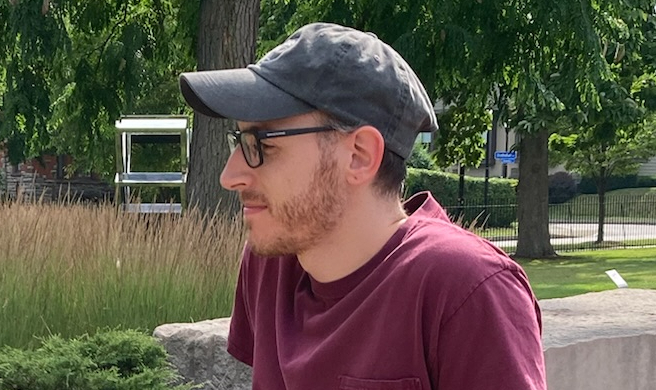
My name is Nick Orlando, and I am a fifth-year Ph.D. candidate at the University of Florida Department of English. I work primarily in film and media studies, but I have maintained an eye toward other areas of academia for some time. At the Press, I interned in two departments, Acquisitions and Editorial, Design, & Production (EDP), during the 2023-2024 academic year. I worked both in-person and remotely, an arrangement that allowed for greater flexibility while I changed hats throughout the day. Most mornings, I would intern at the Press; following that, I would shift to my responsibilities as a graduate student.
Before joining the Press, I was vaguely familiar with a publishing pipeline: one would pitch a manuscript to a press, secure a contract, revise the project, and publish the book. These steps are certainly part of the process, and I think from an author’s perspective this simpler vision of the publication process holds true. Just how involved an author is in the publication process following their submission seems to vary across projects. However, while working closely with Carlynn (assistant editor in acquisitions) and Marthe (managing editor in EDP) at the Press, I realized just how complex and long the publication process is, and how tightly interwoven the departments are.
My internship was perhaps more general than specialized, since the goal was to learn the operations of both the acquisitions and EDP departments simultaneously. I did not work on one particular project. Instead, my efforts were more spread out. With the acquisitions team, I participated in discussions about the types of contracts extended to an author (standard vs. advanced contracts), the preparation of projects for their presentation to the board, and the subsequent preparations necessary for launching board-accepted projects into EDP. I did learn more technical skills, like coding manuscripts to ready them for EDP. But I was most interested in the conversations and procedures that acquisitions departments follow to on-board new projects or see existing projects through. Participating in this capacity shed a lot of light on the purpose of an acquisitions department more generally, demonstrating both its front-facing and internal dimensions. Attending acquisition meetings also revealed the different kinds of books a university press might publish, including scholarly monographs, trade books like travel guides or cookbooks, and short story collections.
Meanwhile, with EDP, I learned about all the components a book project needs to contain before it can be published. This includes copyright and publication information and corrections to page proofs and cover designs at all stages. I also read through and requested corrections to several digital books published through the University Press Scholarship Online service. The work is not necessarily glamorous, but I found the mundanity of it all kind of calming relative to the stresses of the contemporary graduate student experience. And I think it also prevented me from romanticizing academic publishing as some kind of utopian space when compared to the rest of academia.
As if moving between two departments was not enough, both Carlynn and Marthe encouraged me to work with other departments in the press. In this way, the internship was truly mine to craft. I therefore extended help to the marketing department and drafted copy for several book jackets. The marketing manager, Rachel, was very generous with her time. She always provided an abundance of feedback for each submission and explained how my draft was revised to better fit the project or marketing’s writing conventions. Although I have some experience in copywriting as a freelancer, I have never received formal training, though I consider my work with the Press’s marketing team just that.
In all, this internship demystified how complex the process can be and the length of time these projects require. I can say that an internship with a university press is invaluable to a graduate education, particularly in a higher education climate that emphasizes professionalization as it shrinks the academic job market. Such an internship affords graduate students a “peek behind the curtain,” so to speak. It immerses them into the very processes they will enter as academics when it comes time to publish a book. It expands one’s CV beyond classes taught, essays published, conferences attended, and organizations joined. But, perhaps more generally, internships in academic publishing actively demonstrate the work required in publishing scholarly manuscripts and other texts, a process that seems invisible to most graduate students and early faculty who have yet to publish their first book.
Nicholas Orlando is a PhD candidate in the Department of English at the University of Florida. He works primarily within the domain of film and media studies, with emphases on critical theory, spatial theory, and information and technology studies. His dissertation investigates the aesthetics and politics of fun in postmodernity. He has published works in Excursions Journal, CEA Critic, ImageTexT, and the recent edited collection American Science Fiction Television and Space (2023).

 The Florida Bookshelf